
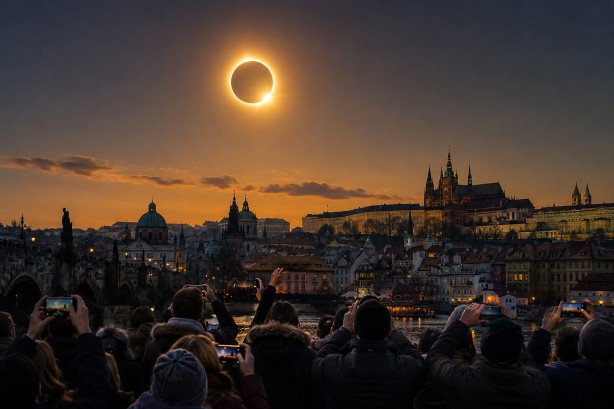
On August 12, the Czech Republic is set to experience a remarkable astronomical event: its most substantial partial solar eclipse in decades. This celestial occurrence will see the Moon passing between the Earth and the Sun, obscuring over 86% of the Sun’s visible surface across parts of southern and western Bohemia. Notably, astronomers have highlighted this eclipse as the country’s most significant until 2075, making it a rare spectacle for sky gazers.
The partial eclipse will commence shortly after 7:19 p.m. CEST, reaching its peak at approximately 8:11 p.m. CEST. While Czech residents will witness a partial covering of the Sun, those in specific regions of Spain, Iceland, and Greenland will be in for a more dramatic experience with the eclipse reaching its total phase. This event stands out as one of the most significant astronomical displays anticipated to be visible across Europe in 2026, drawing the attention of enthusiasts and scientists alike.
As excitement builds, experts are urging the public to take necessary precautions when observing the eclipse. They stress the importance of using certified eclipse glasses or approved solar filters to protect the eyes. Directly looking at the Sun without adequate protection poses a risk of permanent eye damage, a warning that is crucial for safe viewing.
This upcoming eclipse offers a unique opportunity for people in the Czech Republic to engage with a rare natural phenomenon. It serves not only as a chance for casual observers to marvel at the wonders of the universe but also as a significant event for the scientific community, which continues to study such occurrences to deepen our understanding of celestial mechanics.
As the date approaches, anticipation grows for this extraordinary event. With clear guidelines on how to safely enjoy the sight, the partial solar eclipse is set to captivate viewers and leave a lasting impression, setting the stage for future astronomical events that continue to inspire curiosity and wonder across the globe.